Compression garments for lipedema: the complete guide
The right compression garment is the single highest-impact daily intervention for lipedema. Here is everything you need to choose well.
- Researched against current medical guidelines
- Every claim sourced & linked to a named authority
- Independent — we don’t sell surgery
- Not a substitute for your doctor.
Compression garments are a cornerstone of lipedema care. They reduce pain, heaviness, and swelling and help slow progression — though they don’t change the limb’s size or shape and only work while worn. For lipedema, flat-knit, made-to-measure garments are usually preferred over off-the-shelf circular-knit.
On this page
How does compression help lipedema?
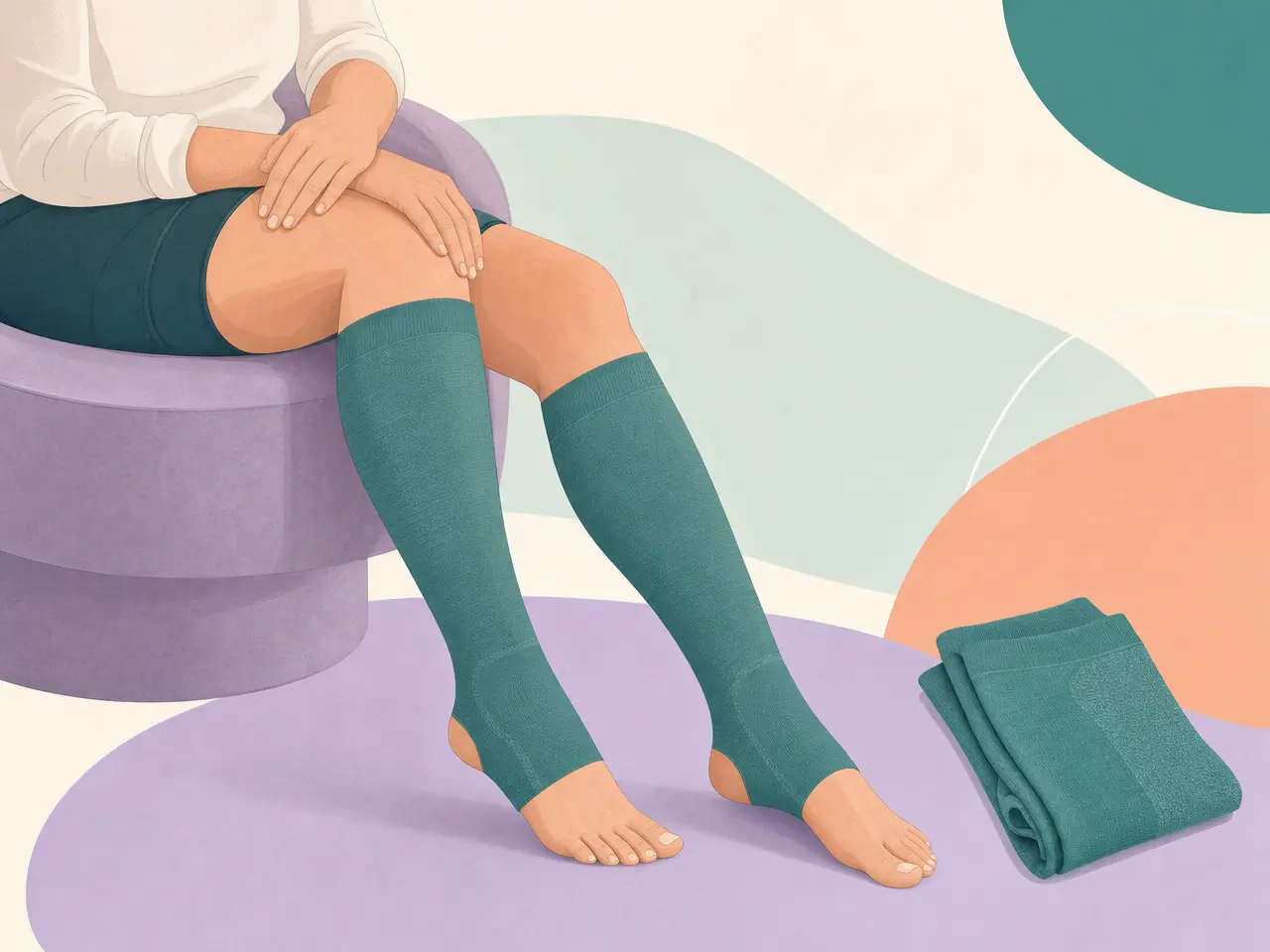
Compression garments apply graduated external pressure to the limb, supporting the walls of the lymphatic and venous vessels and reducing the tendency for fluid and fat to pool. This translates directly into less pain, less heaviness, and reduced swelling by the end of the day.
Compression manages symptoms — it does not change limb size or shape
Wearing compression consistently can significantly improve how you feel and slow progression. It does not shrink the limb or remove lipedema fat. It only works while worn — symptoms return when it is taken off.
Flat-knit or circular-knit — which is better for lipedema?
This is the most important technical decision in compression for lipedema. The two knit types behave very differently on a lipedema limb.
| Feature | Flat-knit (made-to-measure) | Circular-knit (off-the-shelf) |
|---|---|---|
| Construction | Seams run along the length; stiffer fabric | Seamless tube; softer, more elastic |
| Fit on irregular shapes | Bridges lobules and folds without cutting in | Can roll down or cut into soft tissue |
| Pressure profile | More even over uneven contours | Can create constriction at irregular points |
| Customisation | Measured per limb; asymmetry accommodated | Standard sizing; limited to even limbs |
| Best for lipedema? | ✓ Standard recommendation | Fine for early/even limbs only |
| Cost | Higher (often $200–$600+ per garment) | Lower (often $20–$100) |
The lipedema standard
For most people with lipedema beyond the earliest stage, or anyone with lobules, folds, or asymmetry between limbs, flat-knit, made-to-measure garments are the recommended standard — per the Herbst 2021 US Standard of Care. Circular-knit is acceptable for early, even-shaped limbs.
What compression level (mmHg) do I need?
| Situation | Compression class | Knit | Typical garment |
|---|---|---|---|
| Early, no swelling | 20–30 mmHg (US Class I / RAL CCL1, 18–21 mmHg) | Circular OK | Leggings / thigh-high |
| Moderate | 20–30 mmHg (US Class I–II / RAL CCL2, 23–32 mmHg) | Flat-knit preferred | Thigh-high / capri |
| Advanced or any lymphedema | 30–40 mmHg (US Class II / RAL CCL3, 34–46 mmHg), professionally fitted | Flat-knit, custom | Custom flat-knit / wrap |
| Arms | 20–30 mmHg | Flat-knit if lobular | Sleeve (± gauntlet) |
What garment types are available?
- Leggings / capri tights — cover the full leg; the most common choice for lipedema affecting thighs and calves.
- Thigh-highs — for leg involvement from thigh down; need a silicone top band that stays up.
- Knee-highs — for below-the-knee involvement only.
- Arm sleeves — for lipedema or lymphedema of the arms; often paired with a gauntlet.
- Adjustable wraps (Velcro) — ideal for severe cases, poor dexterity, or during intensive phases; easier to don and doff.
How do I measure and wear compression garments?
Measurement matters as much as compression class. Follow these principles:
- 1 Measure first thing in the morning — when swelling is at its lowest.
- 2 If your limbs are asymmetric, measure both — and fit to the larger limb.
- 3 For flat-knit, always get professionally measured — a certified fitter or lymphedema therapist should take your measurements.
- 4 Build up tolerance gradually — start at a lower compression class if a higher class causes pain or skin marks.
- 5 Replace every 3–6 months — elasticity degrades and worn-out garments are much less effective.
- 6 Use donning aids — frames, donning gloves, or applicator tools make putting on tight garments much easier.
Where can I buy compression garments for lipedema?
Affiliate disclosure
This page contains affiliate links. We may earn a commission if you purchase through them — at no extra cost to you. All recommendations are based on clinical standards, not commission rates.
Choose a reputable medical-compression brand that specifies graduated compression. Vendor-neutral options commonly used for lipedema:
- JOBST (Elvarex flat-knit line; widely available in the US)
- Juzo (flat-knit and circular; used by many lipedema specialists)
- Sigvaris (broad range, good flat-knit options)
- medi (mediven and custom flat-knit; available in US and CZ)
- Lipoelastic (specialises in post-surgical and lipedema garments; ships internationally)
- Marena (post-surgical and maintenance)
- Solidea (available in US and CZ)
In the US: compression garments can be partially or fully covered by insurance with a prescription. Talk to your doctor about a prescription for a 'lymphedema/lipedema compression garment.' In Czechia, garments can be prescribed on a poukaz and partially reimbursed by the health insurer.
Sources
- Herbst KL et al. — US Standard of Care, Phlebology 2021 journals.sagepub.com