Lipedema vs lymphedema: what's the difference?
- Researched against current medical guidelines
- Every claim sourced & linked to a named authority
- Independent — we don’t sell surgery
- Not a substitute for your doctor.
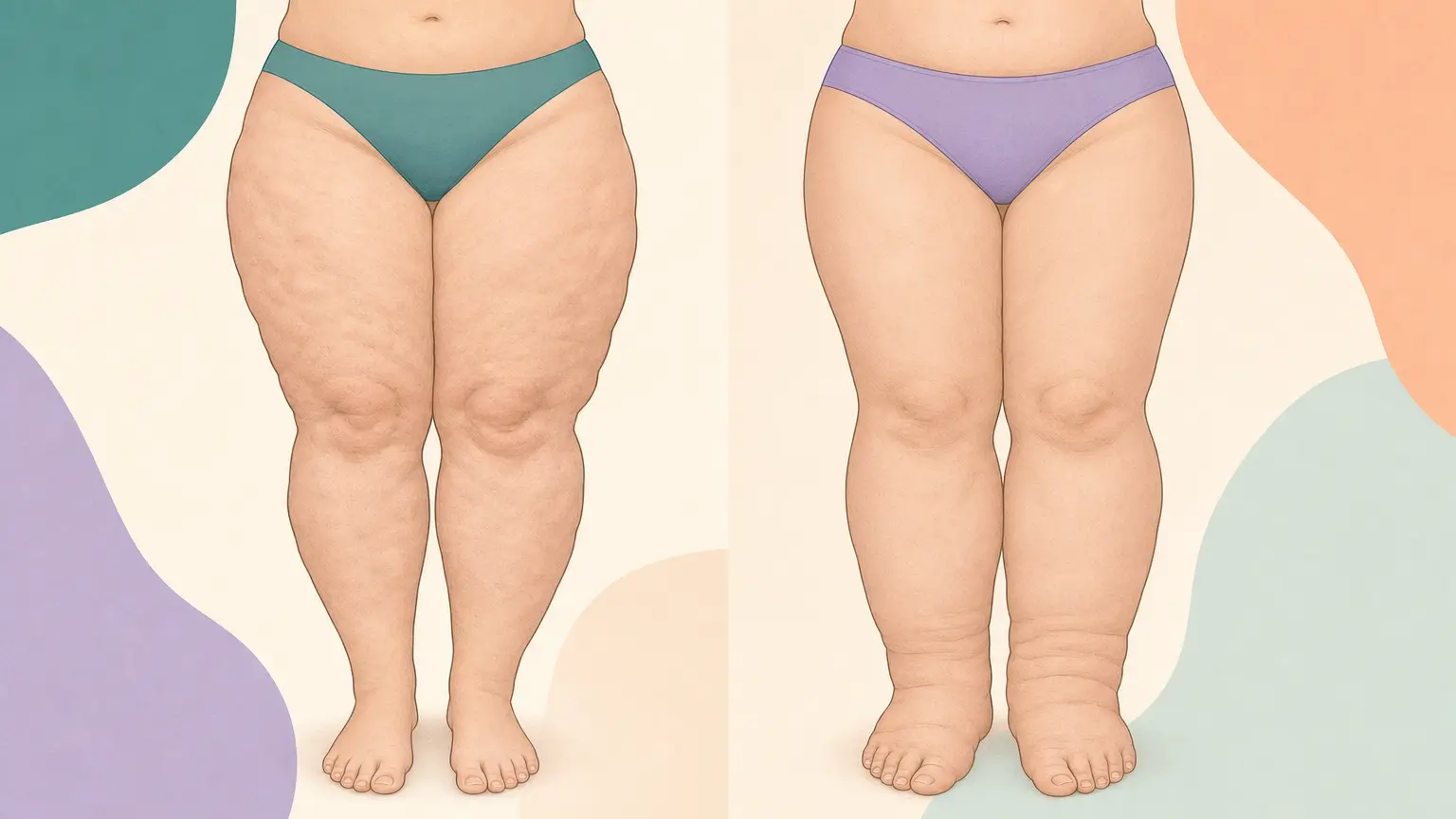
Lipedema is a disorder of fat — symmetrical, painful, bruises easily, and spares the feet. Lymphedema is a build-up of lymph fluid — often one-sided, usually painless, and typically swells the feet and toes. They can occur together ("lipo-lymphedema"), and lymphedema can develop on top of long-standing lipedema.
On this page
Lipedema vs lymphedema at a glance
| Feature | Lipedema | Lymphedema |
|---|---|---|
| What it is | A disorder of fat tissue | A build-up of lymph fluid |
| Symmetry | Both sides, even | Often one side more than the other |
| Feet/toes | Spared — the fat stops at the ankle ("cuff sign") | Swollen — fluid includes the foot and toes |
| Stemmer sign | Negative in pure lipedema (skin lifts normally at the base of the 2nd toe) | Positive — skin at the base of the 2nd toe is too thick to pinch up |
| Pain | Tender, aches easily, bruises with minimal trauma | Heavy, tight, usually not painful |
| Pitting | Minimal or none (fat doesn't pit) | Pitting (press the skin and a dent stays) |
| Onset | Puberty, pregnancy, or menopause | After surgery, cancer treatment, infection, or injury |
What is the Stemmer sign — and what does it actually mean?
The Stemmer sign is a simple skin-pinch test performed at the base of the second toe. A clinician tries to lift a fold of skin: if the skin lifts normally, the test is negative; if the skin is too thickened and fibrous to pinch up, the test is positive.
Critical polarity — never reverse this
The Stemmer sign tests for lymphedema. In pure lipedema it is negative because the feet are spared — the abnormal fat doesn't reach the toes. A positive Stemmer sign means lymphedema is likely present. A positive sign does not rule out lipedema — it means both may be present (lipo-lymphedema).
This is one of the most commonly confused points online. The Stemmer sign does not "diagnose lipedema" — it detects lymphedema. Use it to check whether lymphedema has developed on top of lipedema, not as a standalone lipedema test.
What is the cuff sign?
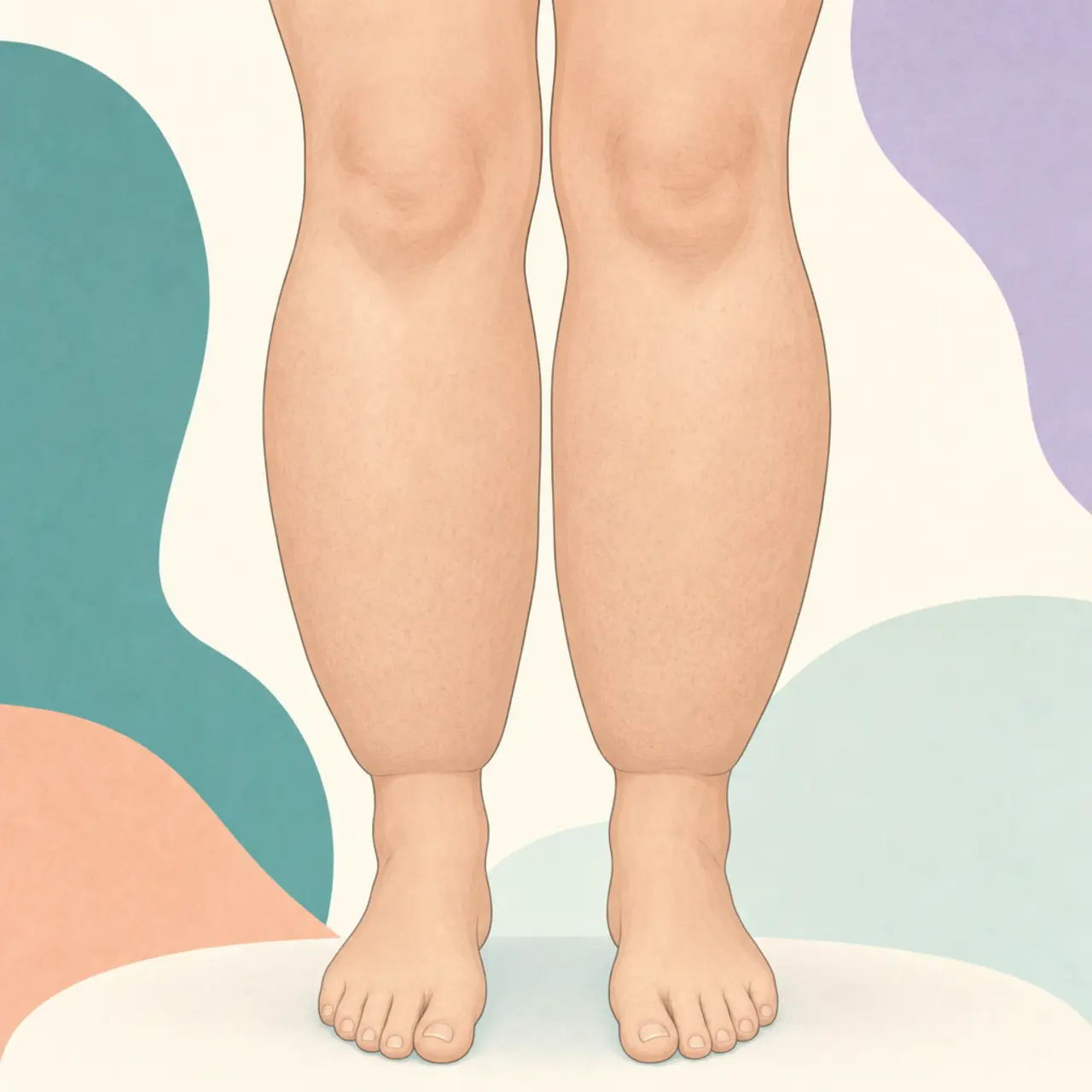
The "cuff sign" or "cuff at the ankle" describes the abrupt stop of lipedema fat at the ankle: the legs are enlarged above the ankle, but the feet stay normal-sized. This creates a visible step — like a bracelet or cuff. It is one of the clearest visual markers of lipedema and distinguishes it from lymphedema, in which the swelling continues into the foot and toes.
What if you have both? (Lipo-lymphedema)
Long-standing lipedema can overload the lymph system over time, leading to secondary lymphedema developing on top of the lipedema — a combined condition called lipo-lymphedema. When this happens, the feet may start to swell, the Stemmer sign becomes positive, and pitting oedema appears. The condition then needs care for both components.
If you've had lipedema for years and notice your feet are now swelling too, that warrants prompt clinical assessment. Early management of lipedema reduces the risk of this progression.
Which condition do I have?
The quickest guide: check your feet. If your feet are normal-sized and the swelling stops at your ankles — that pattern fits lipedema. If your feet and toes are also swollen, and the swelling started after a health event (surgery, infection, cancer treatment) — that fits lymphedema. If you have features of both, consider lipo-lymphedema.
Use our free tool to score your specific symptoms across all four main conditions:
Sources
- Delphi Consensus on Lipedema Diagnosis, Nature Communications 2026 nature.com
- Herbst KL et al. — US Standard of Care, Phlebology 2021 journals.sagepub.com
- Lipedema Foundation lipedema.org