Lipedema vs cellulite: how to tell the difference
- Researched against current medical guidelines
- Every claim sourced & linked to a named authority
- Independent — we don’t sell surgery
- Not a substitute for your doctor.
Cellulite is a harmless cosmetic dimpling of the skin that most women have. Lipedema is a medical condition: painful, symmetrical fat that bruises easily, feels nodular, and resists diet. The biggest tells — lipedema hurts and is tender; cellulite doesn't. Lipedema resists dieting; cellulite is unrelated to it.
On this page
Lipedema vs cellulite at a glance
| Feature | Lipedema | Cellulite |
|---|---|---|
| Appearance | Disproportionate, symmetrical lower-body fat; can look dimpled | Surface dimpling on thighs, buttocks; "orange-peel" texture |
| Texture | Small nodules (rice/pea-sized) under the skin; rubbery | Puckered surface skin; no deep nodules |
| Pain | Tender to touch, bruises easily, aches with pressure | Painless — purely cosmetic |
| Bruising | Easy, spontaneous bruising common | Not a feature |
| Diet response | Resists diet and exercise; upper body may shrink but legs hold on | Unrelated to weight or diet |
| Is it medical? | Yes — a recognised progressive disorder needing care | No — a cosmetic variant of normal anatomy |
What is cellulite?
Cellulite is a harmless structural feature of skin — fibrous cords tethering skin to deeper tissue pull the fat layer into dimples. It's extremely common: around 80–90% of adult women have some degree of it. It is not a disease, it doesn't hurt, it doesn't progress, and it does not need medical treatment.
Key point
Cellulite is painless, does not bruise, and is not affected by diet. If your legs are tender or bruise easily, that's not cellulite.
What is lipedema?
Lipedema is a recognised fat disorder — not a lifestyle consequence and not cosmetic. It causes symmetrical, disproportionate fat that builds up in the legs (and often the arms), feels nodular under the skin, is tender to the touch, and bruises easily with minimal cause. Crucially, it resists diet and exercise: you can lose weight from the upper body while the lipedema fat holds firm. It typically starts at puberty, pregnancy, or menopause, which suggests a hormonal trigger on a genetic background.
Learn more on our what is lipedema? page.
The 4 quick questions to tell them apart
If you're unsure whether what you're seeing and feeling is cellulite or something more, these four questions are a useful first filter:
- 1 Does it hurt? Cellulite is painless. If the fat in your legs or arms is tender when pressed, aches after standing, or hurts when knocked, that is not normal cellulite behavior.
- 2 Does it bruise easily? Cellulite doesn't cause spontaneous or easy bruising. Lipedema fat bruises with minimal trauma — sometimes for no apparent reason.
- 3 Can you feel small nodules? Deep under lipedema skin you can often feel pea- or rice-sized rubbery lumps. Cellulite dimples are a surface texture, not deep lumps.
- 4 Does diet change it? If you've lost weight elsewhere but your legs stubbornly stayed the same, that diet-resistance pattern points toward lipedema.
Not a diagnosis
These questions are a starting-point, not a diagnosis. A knowledgeable clinician needs to assess you in person. Use the Differentiator Tool below as a next step.
Can you have lipedema and cellulite at the same time?
Yes. Because cellulite is so common, many women with lipedema also have cellulite on top of it. The surface dimpling of cellulite can mask the deeper nodular texture of lipedema, which is one reason lipedema goes unrecognised for so long. The presence of cellulite doesn't make lipedema any less likely — look for the pain, bruising, and diet-resistance as the distinguishing markers.
What do they look like? (Pictures)
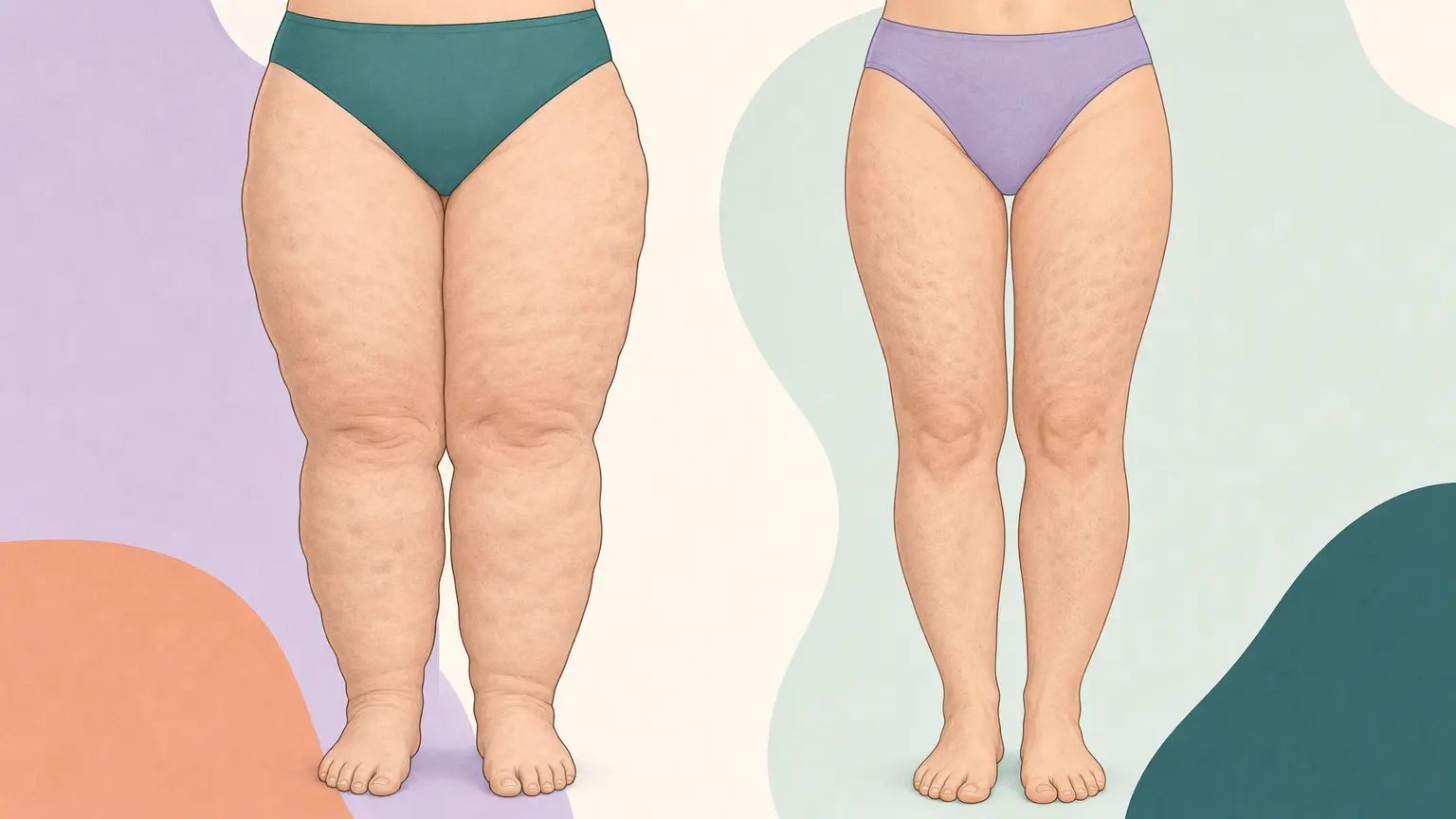
The illustration above shows the contrast between lipedema (left) — heavier, more uniform swelling with deeper nodular texture — and cellulite (right) — surface dimpling with no deep mass effect. Labels are added in the illustration above for clarity; always check both texture and tenderness in person.
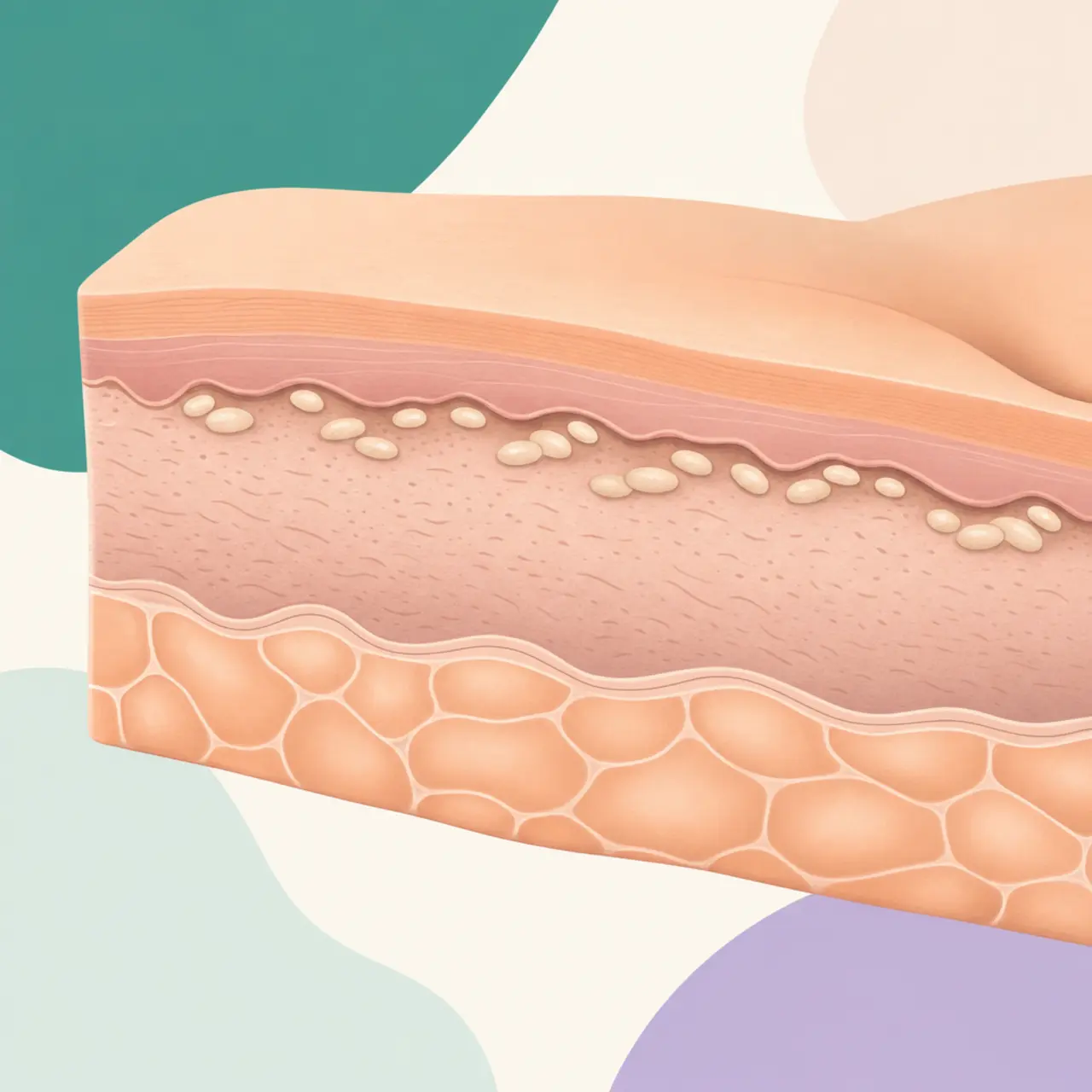
Close-up: the pea- and rice-like nodules felt under lipedema skin. These are not visible from the outside but can be felt by lightly pressing or rolling the skin between two fingers. They are not present in ordinary cellulite.
Watch: cellulite or lipedema?

Not sure which fits your symptoms? Our free tool scores your answers across lipedema, cellulite, lymphedema, and general weight gain.
Sources
- Herbst KL et al. — US Standard of Care, Phlebology 2021 journals.sagepub.com
- Delphi Consensus on Lipedema Diagnosis, Nature Communications 2026 nature.com
- Lipedema Foundation lipedema.org