Lipedema in the arms: signs and what helps
- Researched against current medical guidelines
- Every claim sourced & linked to a named authority
- Independent — we don’t sell surgery
- Not a substitute for your doctor.
Lipedema commonly affects the upper arms (Type IV) — symmetrical, tender fat from the shoulder to the wrist that spares the hands, creating a "cuff" at the wrist. It often occurs alongside leg lipedema.
On this page
Does lipedema affect the arms?
Yes. Arm involvement (Type IV lipedema) is more common than many people realise — it is often present alongside leg lipedema and sometimes occurs without significant leg involvement. The pattern mirrors leg lipedema: symmetrical, disproportionate fat that is tender to touch, bruises easily, spares the hands (creating a visible "cuff" at the wrist), and resists diet and exercise.
The informal patient term "batwings" or "arm wings" describes the soft, hanging quality of the inner upper arm fat that doesn't firm up despite strength training — consistent with lipedema tissue rather than ordinary arm fat.
What are the signs of lipedema in the arms?
- Symmetrical enlargement of both upper arms (one-sided arm swelling is more likely lymphedema).
- Tenderness and pain when the arms are pressed, knocked, or squeezed — not typical of ordinary arm fat.
- Easy bruising on the upper arms with minimal cause.
- Hands spared — the fat stops at the wrist, leaving the hands and fingers normal-sized. This is the arm equivalent of the cuff sign seen at the ankles.
- Nodular texture — pea/rice-like nodules felt by pressing the inner upper arm.
- Diet-resistance — the arms remain large even when the rest of the body loses weight.
- Arms don't firm up with strength training — muscle develops underneath but the overlying lipedema fat remains.
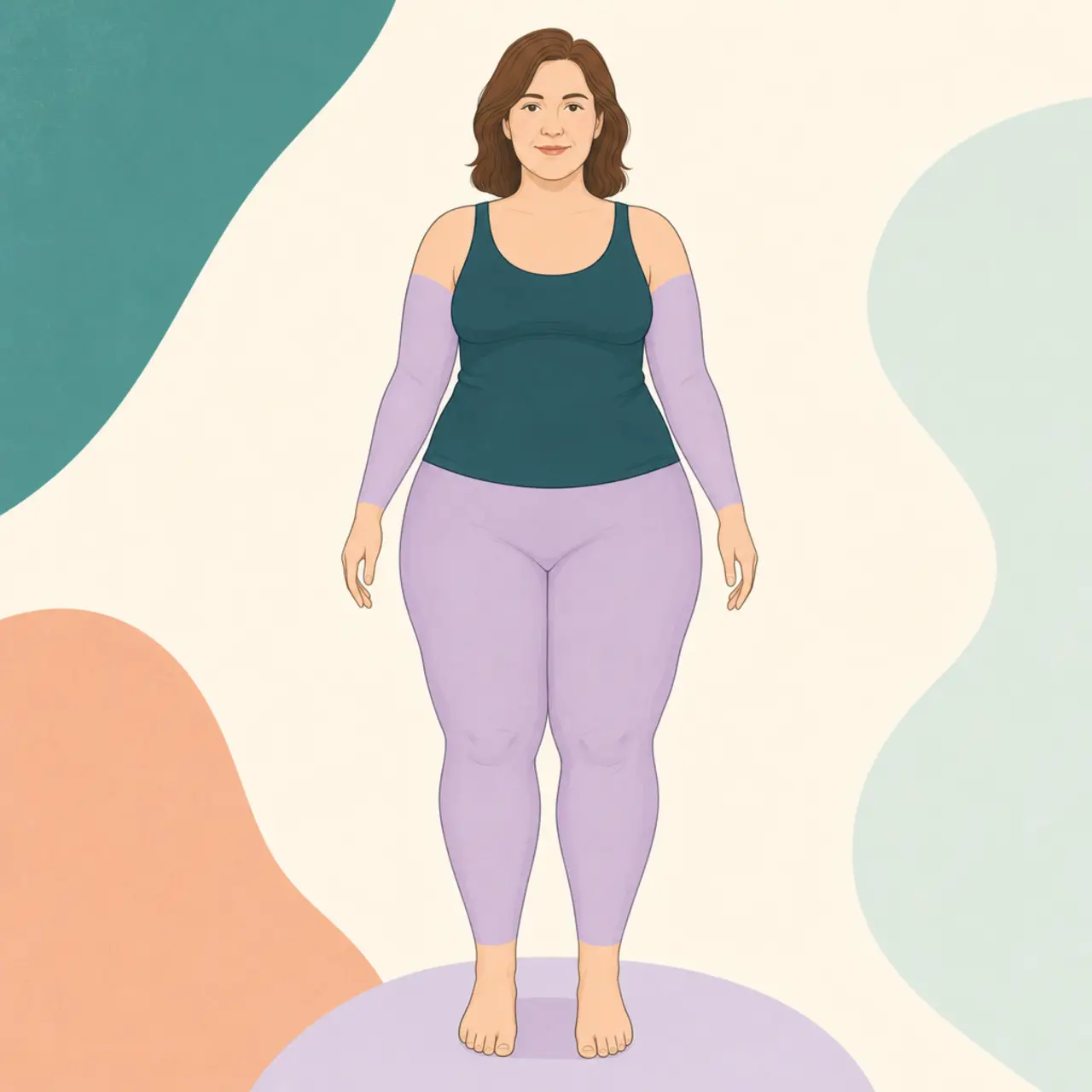
The diagram shows the typical body distribution of lipedema: hips, thighs, and lower legs highlighted, with the upper arms also involved. Hands and feet are unhighlighted — both are spared in pure lipedema.
Arm lipedema vs ordinary arm fat
| Feature | Arm lipedema | Ordinary arm fat |
|---|---|---|
| Symmetry | Both arms, even | Both arms, roughly proportionate to rest of body |
| Tenderness | Tender or painful when pressed | Painless |
| Hands | Spared — normal-sized | Proportionate to arm size |
| Bruising | Easy, spontaneous bruising | Not a feature |
| Diet response | Resists diet and exercise | Reduces with overall weight loss |
| Texture | Nodules under the skin | Soft, uniform |
What helps arm lipedema?
The same principles apply as for leg lipedema:
- Compression arm sleeves — reduce swelling, support lymph flow, and can ease daily discomfort. Must be properly fitted; round-knit sleeves from pharmacies are usually inadequate for lipedema — custom flat-knit or high-quality medical sleeves are more effective.
- Manual lymphatic drainage (MLD) — gentle specialist massage that supports lymph movement; particularly useful for arms.
- Movement — swimming, yoga, and resistance exercise help; avoid activities that cause significant arm pain.
- Liposuction (water-jet or tumescent, power-assisted) — specialised liposuction can reduce arm lipedema tissue in appropriate candidates; outcomes are generally good. This does not cure lipedema but can substantially reduce volume and pain.
Can lipedema be only in the arms?
Yes, though it is less common than leg-dominant presentations. Some people have Type IV lipedema (arms only) without significant leg involvement. The signs are the same: tenderness, symmetry, easy bruising, spared hands, and diet-resistance in the arms.
Sources
- Herbst KL et al. — US Standard of Care, Phlebology 2021 journals.sagepub.com
- Lipedema Foundation lipedema.org