Lipedema or "just fat"? How to tell
- Researched against current medical guidelines
- Every claim sourced & linked to a named authority
- Independent — we don’t sell surgery
- Not a substitute for your doctor.
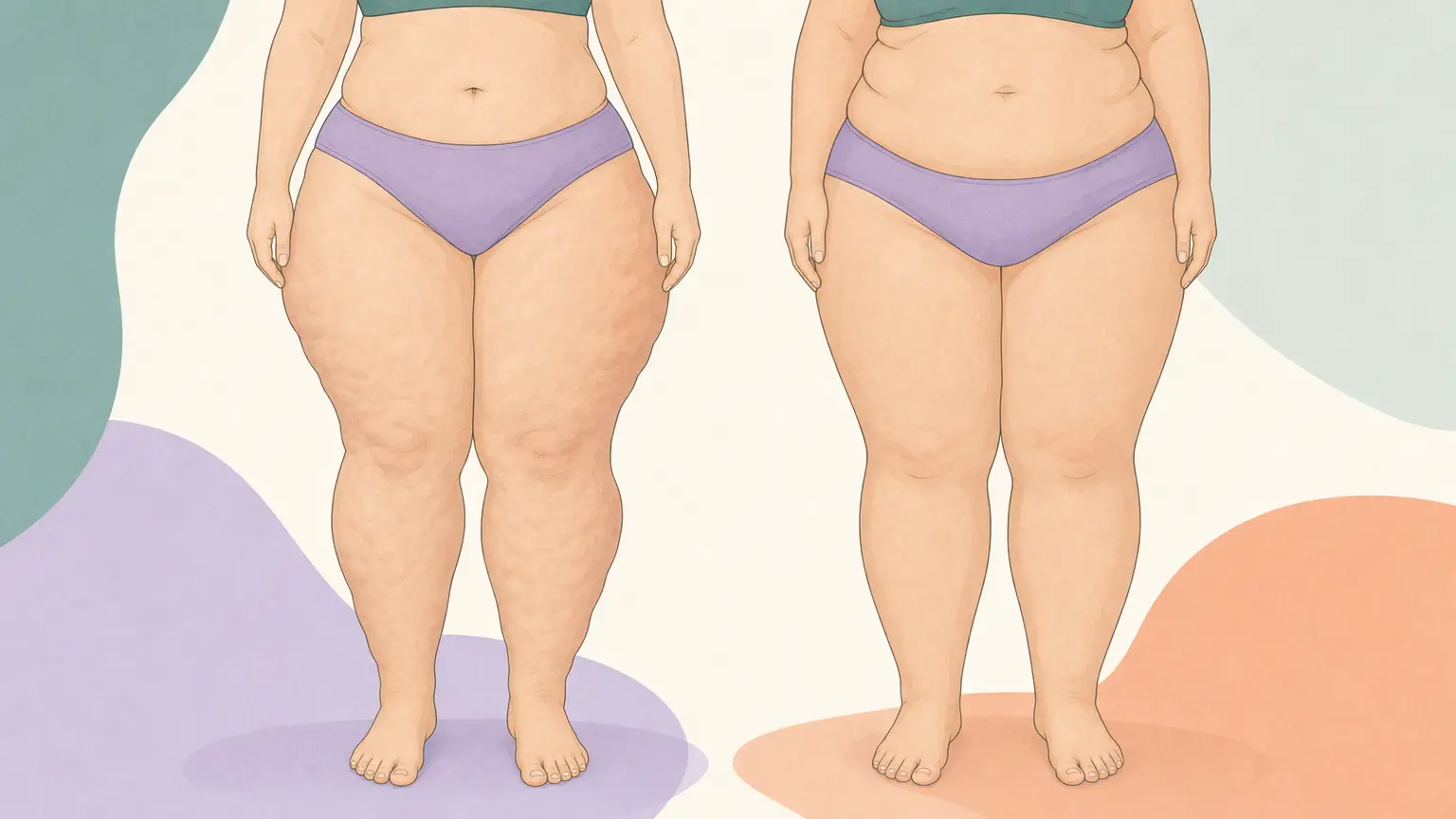
Ordinary excess weight is fairly proportionate, painless, and responds to diet. Lipedema fat is symmetrical and disproportionate (bigger lower half), painful, bruises easily, feels nodular, spares the feet, and resists diet. People with lipedema also tend to have lower rates of diabetes and high blood pressure than their body size would predict.
On this page
Lipedema vs ordinary weight gain at a glance
| Feature | Lipedema | Ordinary weight gain |
|---|---|---|
| Distribution | Symmetrical, disproportionate: lower body much larger than upper body | Fairly proportionate across the body |
| Pain | Tender to touch, aches with pressure, bruises easily | Painless |
| Bruising | Easy spontaneous bruising | Not a feature |
| Diet response | Resists diet and exercise — legs hold firm while upper body shrinks | Responds to calorie deficit; more proportionate loss |
| Feet | Spared — fat stops at the ankle ("cuff sign") | Proportionately enlarged or normal |
| Metabolic health | Often better than size suggests — lower diabetes/hypertension rates | Tracks expected metabolic risk with BMI |
Why does the difference matter?
"Just lose weight" is the most common — and most damaging — dismissal people with lipedema hear. It's the #1 misdiagnosis. The problem: diet and exercise reduce non-lipedema fat but leave the lipedema fat largely intact. Pushing harder on restriction often leads to disordered eating, muscle loss, and deeper distress, without touching the actual problem.
It's not your fault
Lipedema fat resists diet because it has a different biological structure — not because you're not trying hard enough. Many people with lipedema have spent years following strict diets and exercise plans with minimal lower-body change. That pattern is itself a diagnostic clue.
Getting the right diagnosis changes the treatment path entirely: from repeated failed diets to evidence-based options like compression therapy, manual lymphatic drainage, and — in appropriate cases — specialised liposuction. (Aday et al., 2024) found a mean diagnostic delay of around 17 years in a 707-patient US survey.
Can you have lipedema and also be overweight?
Yes — and this is very common. Around 80% of people with lipedema also carry extra weight. (Herbst et al., 2021) The two conditions co-exist and can interact: extra body weight can worsen lipedema symptoms and progression, and the metabolic changes of obesity can add to the inflammatory picture. But the lipedema fat itself is distinct — reducing overall weight may help general health and ease some symptoms, but it will not remove the lipedema fat.
The "size 6 on top, size 14 on bottom" pattern
One of the most recognisable presentations of lipedema is a marked disproportion between the upper and lower body. A person may wear a small shirt size but need trousers or jeans several sizes larger. The waist is relatively normal; the hips, thighs, and lower legs are disproportionately enlarged. This pattern persists even after significant calorie restriction — because the enlarged area is lipedema fat, not ordinary fat.
It's worth noting that not everyone with lipedema fits this dramatic picture. Some presentations are subtler, especially early on or in slim women. See our lean lipedema page.
Use our free tools to check whether your symptoms fit lipedema better than ordinary weight:
Sources
- Aday et al. — 707-patient US survey, Vascular Medicine 2024 pmc.ncbi.nlm.nih.gov
- Herbst KL et al. — US Standard of Care, Phlebology 2021 journals.sagepub.com
- Lipedema Foundation lipedema.org